
Introduction
When you’re starting out in woodworking, a table saw can be both exciting and intimidating. It’s a powerful tool capable of producing precise, professional-quality cuts, but small errors in setup or technique can lead to poor results—or even dangerous accidents.
The good news? Most beginner mistakes are easy to fix once you understand what causes them.
In this guide, we’ll explore five of the most common table saw mistakes, explain the problems they create, and show you exactly how to avoid them so your woodworking is safer, faster, and more accurate.
Mistake #1: Using a Dull or Wrong Blade
Why It’s a Problem
- Dull blades tear fibers instead of cutting cleanly, causing rough edges, burn marks, and chipping.
- Using the wrong blade type (e.g., a rip blade for crosscuts) can lead to poor results and excessive strain on the saw.
How to Avoid It
- Choose the right blade for the job:
- Rip Blade (24 teeth) – Fast, clean cuts along the grain.
- Crosscut Blade (60–80 teeth) – Smooth cuts across the grain.
- Combination Blade (40–50 teeth) – Good for general use.
- Dado Blade Set – For grooves and joints.
- Maintain sharpness by cleaning resin buildup with a blade cleaner.
- Replace blades when sharpening no longer restores clean cuts.
Pro Tip: Keep at least two high-quality blades—one for ripping and one for crosscutting—and switch as needed instead of forcing one blade to do everything.
Mistake #2: Incorrect Blade Height
Why It’s a Problem
- Too high: Exposes more blade than needed, increasing risk of injury and creating rougher cuts.
- Too low: Can cause binding, kickback, and incomplete cuts.
How to Avoid It
- Set the blade so the top tooth is 1/8″–1/4″ above the material.
- Use the saw’s height adjustment wheel before each cut.
- Double-check when switching from thin plywood to thick hardwood.
Pro Tip: Lower the blade when not in use. It’s a small safety habit that prevents accidental contact.
Mistake #3: Misaligned Fence or Miter Gauge
Why It’s a Problem
A fence that isn’t parallel to the blade can pinch the wood, causing dangerous kickback or uneven cuts.
A miter gauge that’s out of square will throw off every angle cut you make.
How to Avoid It
- Check alignment regularly using a combination square:
- Fence → parallel to miter slots
- Blade → parallel to miter slots
- Adjust as needed—most fences have fine-tuning screws.
- Use only one guide at a time:
- Fence for ripping
- Miter gauge for crosscuts
Pro Tip: Never use the rip fence and miter gauge together on the same cut—it can trap the wood between the guides, leading to kickback.
Mistake #4: Feeding Material Too Fast or Too Slow
Why It’s a Problem
- Too fast: Rough edges, tear-out, and risk of binding.
- Too slow: Burn marks and unnecessary wear on the blade.
- Both can throw off accuracy and cause dangerous situations.
How to Avoid It
- Maintain a steady, controlled feed rate—firm but not forced.
- Listen to the saw: A consistent pitch means you’re feeding at the right speed.
- Use featherboards for better control on longer rips.
Pro Tip: Let the blade do the work—if you’re pushing hard, the blade may be dull or the fence misaligned.
Mistake #5: Ignoring Safety Features
Why It’s a Problem
Many beginners remove blade guards, riving knives, and anti-kickback pawls because they feel restrictive.
However, these features exist for one reason—to save your fingers and your life.
How to Avoid It
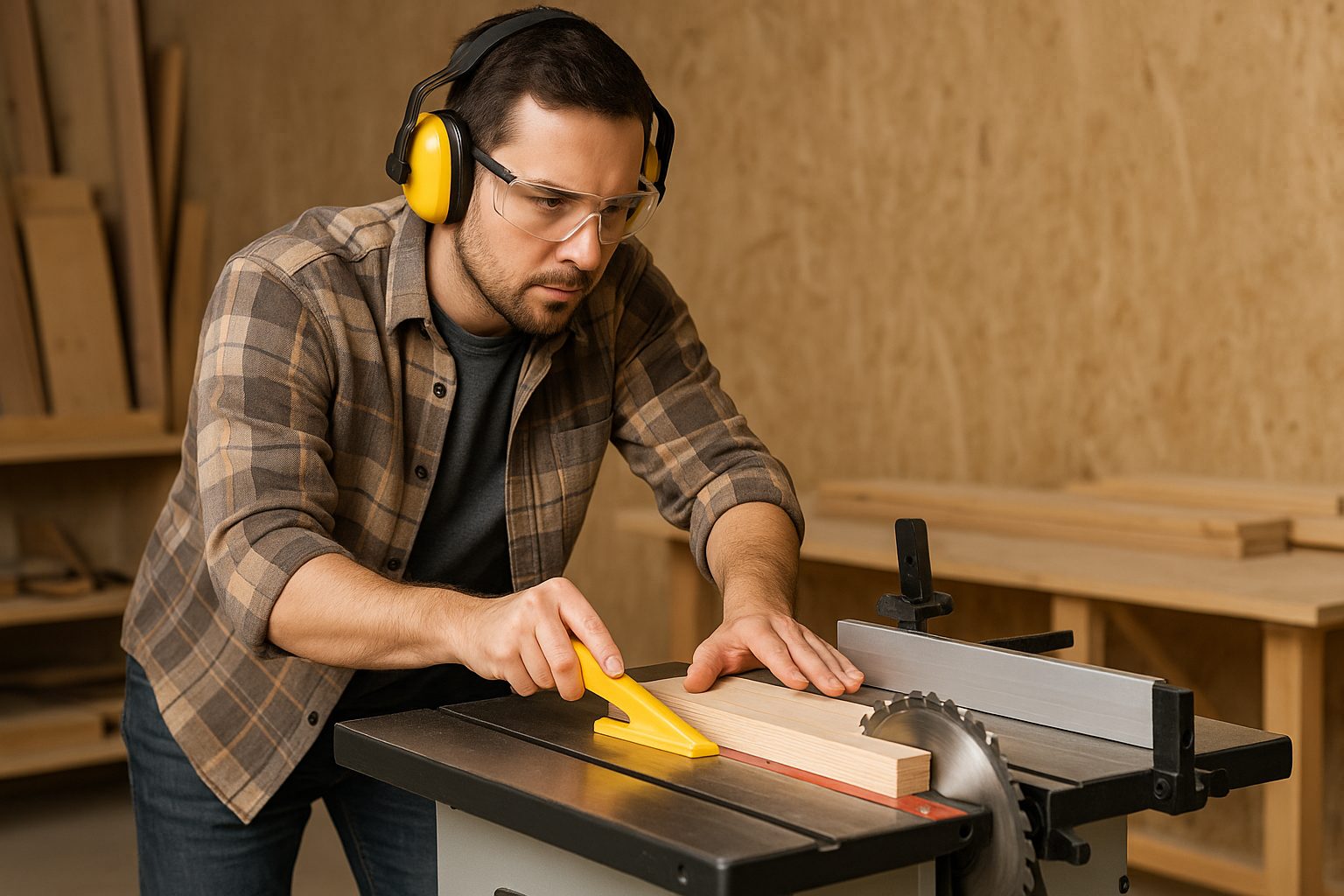
- Always use the riving knife—it prevents kickback by keeping the kerf open.
- Keep the blade guard installed whenever possible, especially for through cuts.
- Use push sticks or push blocks for narrow rips.
- Stand slightly to the side of the cut line to avoid direct kickback path.
Pro Tip: If you must remove a guard for a specific cut (like a dado), replace it immediately after you’re done.
Bonus Mistake: Not Preparing the Work Area
Even with perfect technique, a cluttered or poorly lit space increases accident risk.
- Keep the tabletop clean and waxed.
- Remove sawdust buildup under the insert plate.
- Ensure adequate lighting over the saw.
Conclusion
Every woodworker makes mistakes in the beginning—but by identifying and correcting these five common table saw errors, you’ll work safer and produce cleaner, more accurate cuts.
Remember:
- Use the right blade.
- Set correct blade height.
- Align your guides.
- Maintain a steady feed.
- Respect safety features.
By avoiding these pitfalls, you’ll speed up your learning curve and enjoy woodworking with confidence.

Anns is a contributor at TableSawGuide. We are committed to providing well-researched, accurate, and valuable content to our readers.
You May Also Like
About the Author
Related Articles
Leave a Comment
Share your thoughts, ask questions, or contribute to the woodworking community!