
Introduction
A table saw is one of the most powerful tools in your workshop — but it’s also one of the most dangerous.
Even experienced woodworkers face risks, especially when making tricky cuts or working long hours.
Fortunately, safety accessories like push sticks, riving knives, and blade guards can dramatically reduce your chances of injury without slowing down your work.
In this guide, we’ll cover:
- What each safety device does
- How it prevents accidents
- When to use it (and when to remove it)
- Recommended products for upgrades
1. Push Sticks – Keep Your Hands Safe
What is a Push Stick?
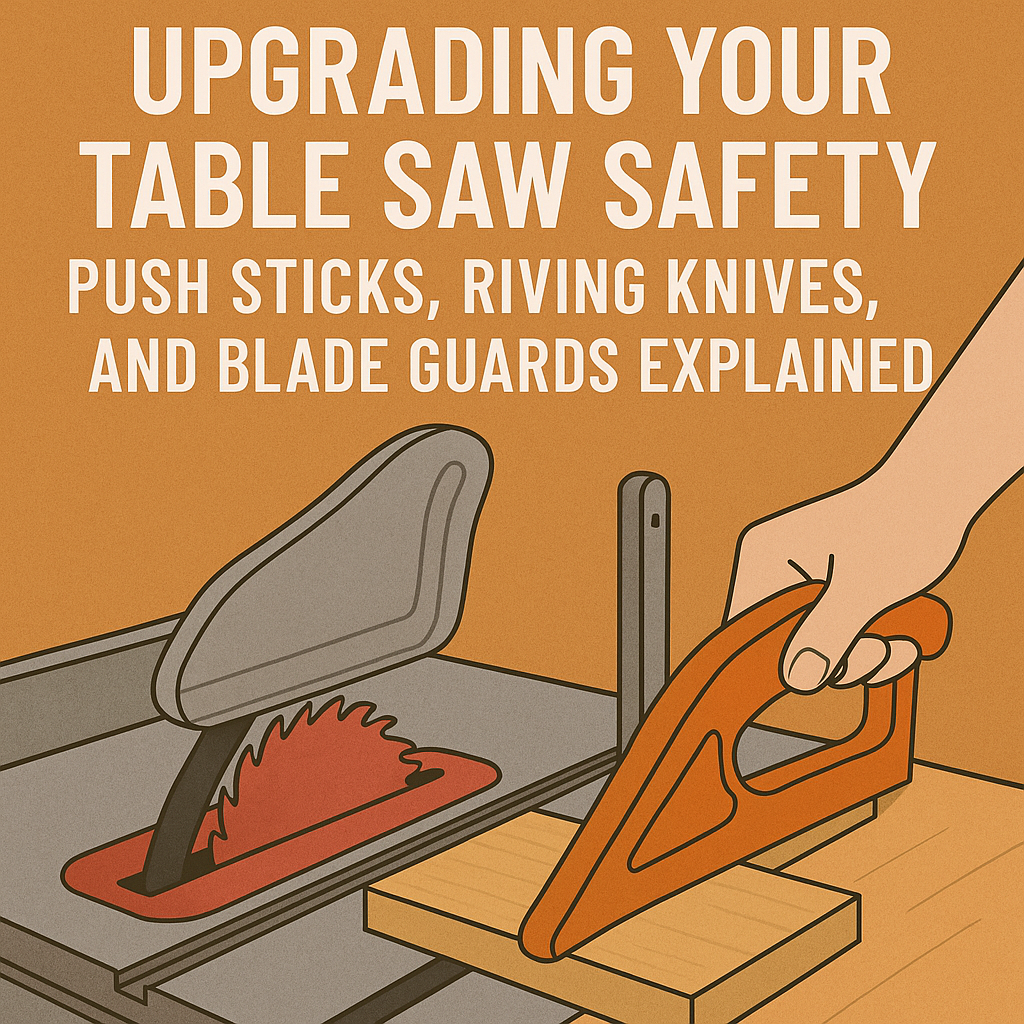
A push stick is a handled tool used to guide the workpiece through the blade while keeping your hands a safe distance away.
Why It’s Important
- Prevents your hands from getting near the blade
- Maintains consistent feed pressure
- Provides better control on narrow cuts
Types of Push Sticks
- Standard Push Stick – Narrow with a hook at the end for pushing stock.
- Push Block – Flat base with handle, good for wider boards.
- Hybrid/Ergonomic Push Stick – Combines both features for versatility.
When to Use It
- Ripping narrow pieces (<3″ wide)
- Cutting long strips of plywood
- Feeding smaller workpieces
Recommended Push Sticks
- GRR-RIPPER 3D Push Block – Adjustable, stable, and excellent for precision work.
- POWERTEC 71009 Safety Push Block and Stick Set – Budget-friendly starter kit.
Pro Tip: Keep multiple push sticks on hand for different cut types so you don’t skip using them.
2. Riving Knives – The Kickback Killer
What is a Riving Knife?
A riving knife is a thin piece of metal that sits directly behind the blade, moving up and down with it. It keeps the kerf (cut gap) open so the workpiece doesn’t pinch the blade.
Why It’s Important
- Reduces kickback — the most common cause of serious table saw injuries
- Keeps cuts smooth by preventing binding
- Works for both through cuts and many non-through cuts
When to Use It
- Always, unless cutting a groove/dado that requires its removal (and reinstall it immediately after)
- Especially important when ripping long boards
Recommended Riving Knives
- Use the manufacturer’s OEM riving knife for your saw (check your saw’s manual).
- If your saw doesn’t have one, look for aftermarket retrofits like MicroJig Splitter Systems.
Pro Tip: Avoid older table saws without a riving knife — retrofitting is worth the cost for safety.
3. Blade Guards – Shielding the Danger
What is a Blade Guard?
A blade guard is a transparent shield that covers the blade during cutting, preventing accidental hand contact and deflecting debris.
Why It’s Important
- Creates a physical barrier between your hands and the blade
- Helps contain flying chips and sawdust
- Works with most through cuts
Common Complaints (and Why They’re Wrong)
Some woodworkers remove guards, claiming they get in the way. In reality:
- Modern blade guards are clear and easily removable for special cuts.
- Most guards can be reinstalled in seconds.
Recommended Blade Guards
- Stick with your saw’s factory guard if available.
- If upgrading, consider an overarm blade guard with dust collection, like the Excalibur Overarm Guard.
4. Other Safety Accessories Worth Adding
- Featherboards – Hold stock firmly against the fence.
- Zero-Clearance Inserts – Reduce tear-out and keep offcuts from falling into the blade slot.
- SawStop Brake Technology – Stops the blade instantly if it touches skin.
5. Best Practices for Using Safety Devices
- Always reinstall safety gear immediately after a cut that requires its removal.
- Store push sticks within arm’s reach of the saw.
- Inspect your riving knife and blade guard for damage regularly.
- Combine accessories — e.g., push stick + featherboard — for maximum safety.
Conclusion
Upgrading your table saw safety setup with quality push sticks, a well-aligned riving knife, and a properly installed blade guard is one of the cheapest, easiest, and smartest investments you can make.
These tools don’t just prevent injuries — they improve control, accuracy, and confidence at the saw.

Anns is a contributor at TableSawGuide. We are committed to providing well-researched, accurate, and valuable content to our readers.
You May Also Like
About the Author
Related Articles
Leave a Comment
Share your thoughts, ask questions, or contribute to the woodworking community!