
Introduction
Even the best table saw can develop performance issues over time — and most of them have simple fixes if you know what to look for.
Whether you’re dealing with burn marks on wood, cuts that aren’t square, or unusual vibration, this guide will help you identify the cause and correct it.
We’ll cover:
- Common table saw problems
- Likely causes
- Step-by-step solutions
- Preventive tips to keep issues from returning
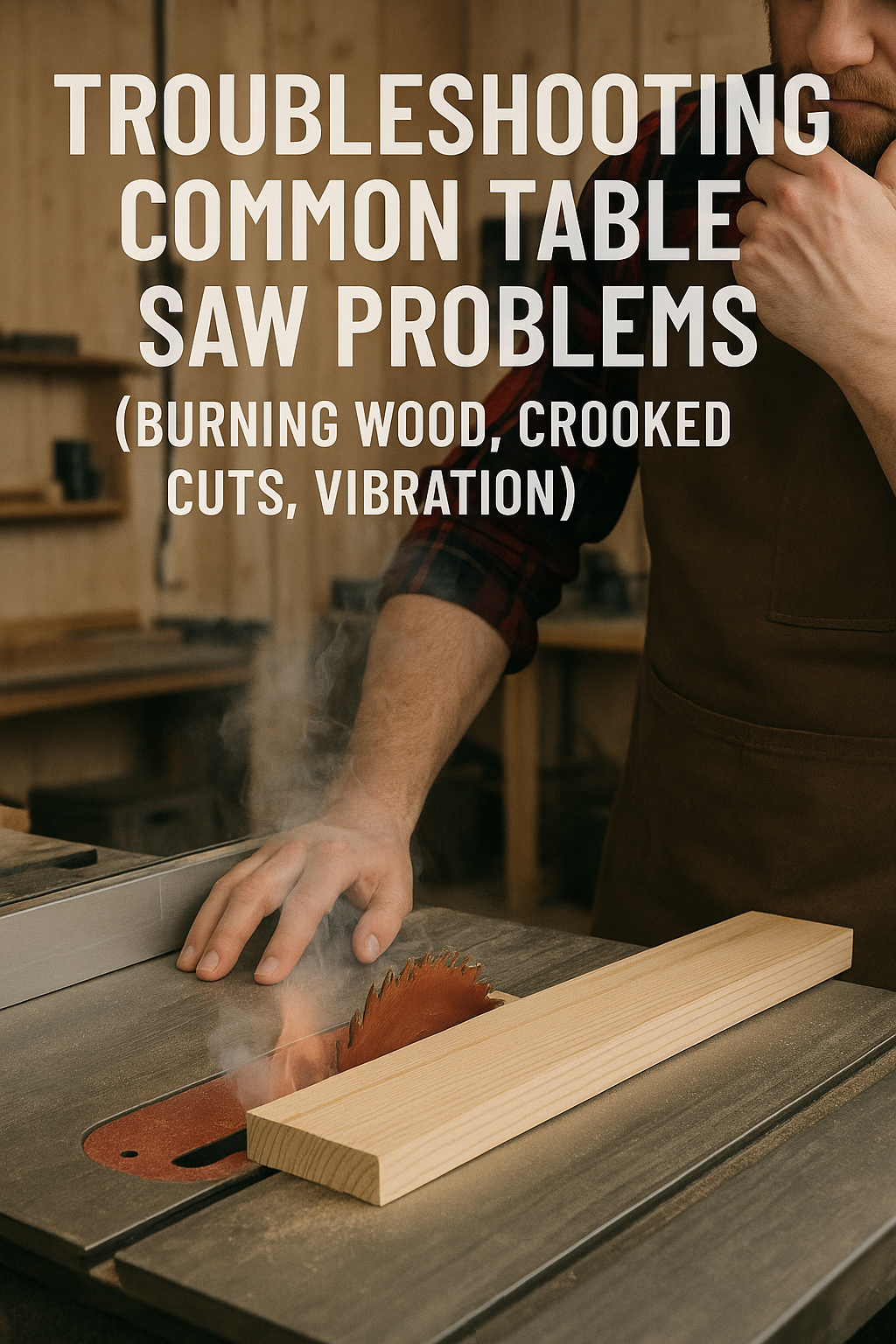
1. Problem: Burning Wood
Symptoms:
- Dark scorch marks along the cut
- Smell of burning wood
- Extra resistance when feeding material
Likely Causes:
- Dull blade – Requires more force to cut.
- Misaligned blade or fence – Pinches the wood during the cut.
- Feeding too slowly – Friction builds up.
- Resin buildup on blade – Increases heat.
Solutions:
- Sharpen or replace blade if teeth are dull.
- Clean blade with resin remover or mineral spirits.
- Check alignment between blade, fence, and miter slots.
- Increase feed rate slightly to reduce friction.
Pro Tip: For hardwoods, use a dedicated rip blade with fewer teeth to reduce heat buildup.
2. Problem: Crooked or Inaccurate Cuts
Symptoms:
- Cuts that aren’t square to the edge
- Boards that vary in width despite same fence setting
Likely Causes:
- Fence not parallel to blade – Causes drift.
- Blade tilt miscalibration – Off from true vertical.
- Warped wood – Naturally curves during the cut.
Solutions:
- Align fence so it’s perfectly parallel to miter slot and blade.
- Check blade tilt with a digital angle gauge.
- Inspect workpiece for warping before cutting.
Pro Tip: A crosscut sled ensures perfectly square crosscuts, even if your miter gauge is slightly off.
3. Problem: Excessive Vibration
Symptoms:
- Saw shakes noticeably during operation
- Cuts feel rough or wavy
Likely Causes:
- Unbalanced blade – Worn or damaged teeth.
- Loose mounting bolts – Motor or trunnions not secure.
- Damaged arbor bearings – Wear over time.
- Uneven surface – Saw isn’t stable.
Solutions:
- Replace blade if warped or damaged.
- Tighten all bolts connecting motor, trunnions, and stand.
- Check arbor bearings — replace if worn.
- Level the saw on a flat, stable surface.
Pro Tip: Use vibration-dampening pads under portable saw stands.
4. Problem: Kickback
Symptoms:
- Workpiece violently thrown back toward operator
- Sudden jerk or noise during cut
Likely Causes:
- No riving knife installed – Kerf closes behind blade.
- Fence misalignment – Pinches wood against blade.
- Twisted or warped wood – Moves unpredictably during cut.
- Feeding at an angle – Material binds against blade.
Solutions:
- Always use a riving knife or splitter.
- Ensure fence alignment with blade.
- Only cut flat, straight wood.
- Maintain steady, straight feed through the blade.
Pro Tip: Featherboards help keep stock firmly against the fence, reducing side movement.
5. Problem: Rough or Splintered Cuts
Symptoms:
- Edges tear out
- Veneer chips away
- Surfaces feel jagged
Likely Causes:
- Wrong blade type – Rip blade for plywood or fine work.
- Dull teeth – Tear fibers instead of slicing cleanly.
- No zero-clearance insert – Fibers fall into the throat plate gap.
Solutions:
- Use a fine-tooth crosscut blade for plywood and veneered boards.
- Sharpen or replace blade as needed.
- Install a zero-clearance insert to support the wood fibers.
6. Problem: Blade Won’t Stay at Set Height or Angle
Symptoms:
- Blade drifts down during a cut
- Blade tilt changes unexpectedly
Likely Causes:
- Loose locking mechanism – Height or tilt lock not tight.
- Worn gears – Cannot hold blade position.
- Dust in adjustment mechanism – Prevents full lock.
Solutions:
- Tighten lock knobs securely before cutting.
- Clean gears and adjustment screws.
- Replace worn locking components.
7. Problem: Motor Struggles or Stalls
Symptoms:
- Blade slows or stops mid-cut
- Saw overheats
- Circuit breaker trips
Likely Causes:
- Dull blade – Overloads motor.
- Feeding too quickly – Motor can’t keep up.
- Extension cord too long/thin – Voltage drop reduces power.
- Internal motor issue – Brushes or wiring fault.
Solutions:
- Sharpen or replace blade.
- Slow down feed rate for thick hardwoods.
- Use heavy-gauge extension cord (12 AWG or thicker) if needed.
- If problem persists, have motor serviced.
Preventive Maintenance Tips
- Clean blade regularly to prevent resin buildup.
- Check alignment every few months.
- Keep moving parts lubricated.
- Store saw in a dry, dust-free environment.
- Replace worn safety components immediately.
Conclusion
Most table saw problems come down to dull blades, poor alignment, or lack of maintenance.
By regularly checking your setup, keeping your saw clean, and addressing small issues early, you can keep your cuts accurate, your work safe, and your saw running like new.

Anns is a contributor at TableSawGuide. We are committed to providing well-researched, accurate, and valuable content to our readers.
You May Also Like
About the Author
Related Articles
Leave a Comment
Share your thoughts, ask questions, or contribute to the woodworking community!