
Introduction
A table saw is the backbone of most woodworking shops—whether you’re a weekend DIYer or a seasoned cabinetmaker. While beginners focus on basic cuts, professionals rely on refined techniques to produce flawless, repeatable resultsand work with maximum efficiency.
In this guide, we’ll explore 15 professional table saw tips that can instantly improve your:
- Accuracy – Every cut perfectly square, every time
- Efficiency – Faster workflow with less setup time
- Safety – Fewer risks, more control
These are the same tricks pros use daily, and most require nothing more than good habits, simple tools, and a little preparation.
1. Master Your Setup Before Cutting
Professionals spend as much time setting up as cutting.
- Blade parallel to miter slots: Reduces burning and kickback.
- Fence perfectly parallel to blade: Ensures straight rips.
- Miter gauge square: Guarantees accurate crosscuts.
Pro Tip: Mark a “go-to” alignment on your fence and miter gauge so you can return to perfect settings quickly.
2. Use the Right Blade for the Job
Using one blade for every cut works—but switching blades for specific tasks elevates your work.
- Ripping hardwood: 24T rip blade.
- Crosscutting plywood: 80T fine crosscut blade.
- General work: 40–50T combination blade.
Pro Tip: Keep blades clean. Resin buildup causes burning and forces the motor.
3. Install a Zero-Clearance Insert
A zero-clearance insert has a kerf cut matching your blade, reducing tear-out and improving cut quality—especially on plywood and veneered materials.
How Pros Use It:
- Swap inserts for different blades and dado widths.
- Replace worn inserts before they develop large gaps.
4. Use Featherboards for Safer, Cleaner Cuts
Featherboards keep material firmly against the fence and table.
- Prevents drifting.
- Improves accuracy.
- Reduces kickback risk.
Pro Tip: Mount two—one before and one after the blade—for long rips.
5. Calibrate Your Miter Gauge or Use a Sled
Stock miter gauges often have slop in the slots.
- Add miter slot shims or washers to remove play.
- For dead-on crosscuts, switch to a crosscut sled.
6. Add a Stop Block for Repeatable Cuts
When cutting multiple pieces the same length, use a stop block clamped to your fence or sled.
- Avoids re-measuring each time.
- Ensures identical lengths.
Pro Tip: Position the block before the blade so offcuts don’t get trapped and cause kickback.
7. Learn the “Tap-Tap” Fence Adjustment
Pros don’t force the fence into place—they tap it with fingertips to fine-tune alignment.
- Avoids over-correcting.
- Saves time compared to repeated locking/unlocking.
8. Keep Your Table Surface Smooth
Friction slows cuts and affects accuracy.
- Clean with mineral spirits to remove gunk.
- Apply paste wax for a slick, protective finish.
Pro Tip: A smooth table also protects wood surfaces from scratches.
9. Use Outfeed Support for Long Stock
Professional shops always have outfeed tables or roller stands.
- Prevents long boards from tipping.
- Improves cut control.
- Reduces tear-out on the trailing edge.
10. Stand in the Right Position
Never stand directly behind the blade’s line of fire—pros angle themselves slightly to avoid potential kickback.
Footwork Tip:
- Feet shoulder-width apart.
- Balanced stance for steady feeding.
11. Control Feed Rate Like a Pro
Too fast = tear-out.
Too slow = burning.
- Maintain smooth, steady pressure.
- Let the blade do the work.
Pro Tip: Listen to your saw—changes in pitch mean you’re feeding unevenly.
12. Support Narrow Rips Safely
For rips under 3″ wide:
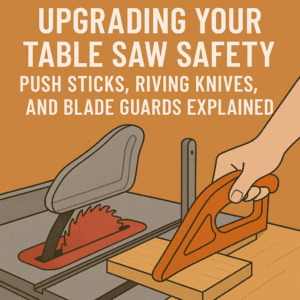
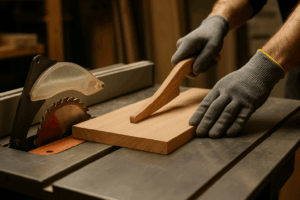
- Use a push stick or push block.
- Keep hands away from blade path.
13. Use Sacrificial Fences for Special Cuts
A sacrificial fence lets you:
- Cut rabbets without damaging your main fence.
- Safely cut dadoes with the fence close to the blade.
14. Store Blades Safely and Accessibly
Pros keep blades organized in labeled cases or wall racks.
- Protects teeth from chipping.
- Saves time when swapping blades.
15. Adopt a Clean-As-You-Go Routine
Sawdust on the table or floor is more than messy—it’s a hazard.
- Brush off tabletop between cuts.
- Vacuum around the saw regularly.
Safety First, Always
Even pros follow basic safety:
- Wear safety glasses and hearing protection.
- Disconnect power before blade changes.
- Avoid loose clothing and jewelry.
Workflow Hacks Pros Use Daily
- Batch processing: Group similar cuts together to reduce setup changes.
- Story sticks: Mark dimensions once and use the stick for repeated cuts.
- Shadow lines: Use overhead lighting to see blade alignment better.
Conclusion
These 15 pro table saw tips will help you cut faster, safer, and with greater accuracy—whether you’re making furniture, cabinetry, or small woodworking projects. By combining proper setup, the right accessories, and smart workflow habits, you’ll work like a professional in no time.

Anns is a contributor at TableSawGuide. We are committed to providing well-researched, accurate, and valuable content to our readers.
You May Also Like
About the Author
Related Articles

Leave a Comment
Share your thoughts, ask questions, or contribute to the woodworking community!